A Reading Corner for a Short Winter Afternoon
A reading corner for a short winter afternoon can work with the chair, nearby surface and daylight you already have, without adding furniture.
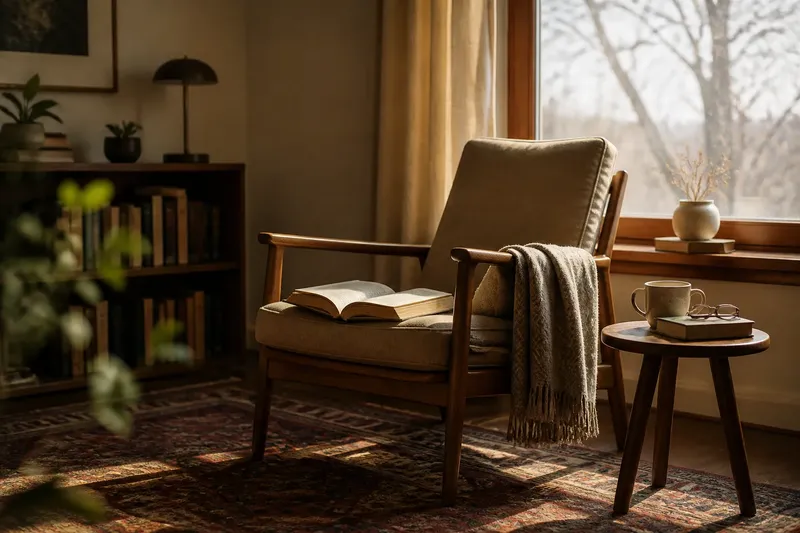
The common mistake in planning a reading corner for a short winter afternoon is to choose the chair first and ask about the light later. The result can be a pleasant seat where a page turns grey before the chapter does. A reading corner for a short winter afternoon works better when you start with the daylight available, then decide how your chair and nearby surface can use it.
Which afternoon light does your room actually get?
Look at the room during the hours you would normally read, rather than judging it on a bright morning. Notice where a clear patch of daylight lands, how quickly it moves, and whether a window faces a wall, trees, or open sky. Those details matter more than the room’s general label as “bright” or “dark.”
For a few afternoons, observe from the chair you already own. You do not need to keep a formal log: a note on your phone about “light on sofa arm” or “glare on pages” is enough to reveal a pattern. The aim is to find a useful relationship between the chair, the page and the window, not to make an amateur weather station.
- Direct sun reaches the chair: Check whether it falls across the page or into your eyes. A slight change in chair angle may keep the light useful without making the seat uncomfortable.
- Daylight is bright but indirect: This often gives an even reading surface. Place the chair where the window remains in view but does not dominate your line of sight.
- The window is bright while the rest of the room is dim: Try a position where you can see the window without facing it directly. The contrast can make a page feel harder to read than the room’s overall brightness suggests.
- Daylight fades early in the room: Choose the place that stays comfortable longest, then plan to use an existing lamp as afternoon turns toward evening.
Where should the chair go if daylight is strong?
If sunlight makes a bright stripe across the page, rotate the chair before moving it across the room. A small change in angle can shift reflections and keep the window out of your direct line of sight. The practical test is simple: settle into the seat, hold a book at your usual distance, and see whether the text remains clear without squinting or tilting the page.
A chair beside a window can feel inviting, but “beside” does not have to mean pressed against the glass. Leaving a little breathing room can reduce the sense of glare and make the spot feel connected to the room rather than parked in a display. If the chair has a high back, check that it does not block the light you hoped to use.
Say you have a dining chair that is comfortable enough for a chapter and a window that sends a bright beam across the rug. Imagine turning the chair so the window sits to one side, then placing a small side table within reach. The expected result is a page lit more evenly and a book or mug that has somewhere to land, without changing the furniture in the room.
What if the useful light comes from behind you?
Light arriving from behind can cast your own shadow across a book, especially if you lean forward. Try turning the chair so the window is beside you instead. If the room’s arrangement leaves no good side-lit position, test the reading position with the book open before deciding that the chair belongs there.
Some readers prefer facing a wall or a quiet corner, while others like to keep the room in view. Treat that preference as part of the decision: a position that offers lovely light but makes you feel exposed may not be the useful one. You are arranging a place to return to, not staging a chair for a catalogue photograph.
How should the nearby surface support the seat?
Use a table, stool, shelf or other stable surface already close to the chair. Its job is modest: hold what you need without forcing you to twist or reach across the reading space. A surface that is too far away can turn every pause into a small interruption; one directly in the way can make the chair feel cramped.
Try the reach from your seated position before moving the surface. Check whether you can set down a book, glasses or a drink without leaning awkwardly, and whether the surface blocks daylight from reaching the page. If it is a narrow table, put the most-used item where your hand naturally falls rather than arranging everything like a miniature shop display.
A nearby surface can also help the corner feel intentional. A lamp, a folded throw or a small stack of books may already be available, but none is essential. Leave open space for the item you actually use; decorative objects are not obliged to form a committee.
Which arrangement fits your room and reading habit?
Choose the arrangement that matches both the daylight and the way you read. These situations are not room types to imitate; they are ways to decide what your existing pieces can do.
- You read for a short stretch near the window: Keep the chair close enough to use the available daylight, but angle it to avoid direct glare. A nearby stool or table is useful if you regularly set down a book or drink.
- You read as the afternoon light fades: Put the chair where the last useful daylight reaches it, then check whether an existing lamp can illuminate the page later. If the lamp leaves a strong shadow, try another position for it rather than assuming the chair must move.
- You prefer a tucked-away seat: Use a quieter corner if it remains comfortable and the page is clear. A chair that faces inward can feel settled, while a nearby surface keeps the arrangement practical.
- You share the room with other activities: Choose a place that can return to its everyday use without a complicated rearrangement. A movable stool or a side table already in the room may give the reading spot enough support without claiming permanent territory.
The best fit may be the chair that is less impressive but easier to use. A deep lounge chair can be comfortable for long reading, yet awkward if it blocks the window or leaves the table out of reach. An ordinary dining chair may be the better choice for a brief afternoon read if its position makes the page clear.
What questions help settle the position?
Should the chair face the window?
Not necessarily. Facing a window can put bright light directly in your eyes or create strong contrast between the page and the room. A sideways position often makes it easier to use daylight without staring into its source.
Can a reading corner work without a side table?
Yes, if you do not need a place to set anything down or can use a stable surface already nearby. Avoid balancing a drink or book on an unstable armrest; convenience loses its charm when it becomes a small rescue operation.
What should I do when the chair is comfortable but the light is poor?
Try changing its angle and testing the page again before moving it far. If daylight still fails, see whether an existing lamp can reach the reading position without causing glare or a hard shadow.
Does the corner need to look separate from the rest of the room?
No. A chair, a useful surface and a workable position can make a reading spot feel distinct without a screen, rug or new furniture. A clear view of the seat and its purpose is usually enough.
What is not worth rearranging?
Do not move heavy furniture simply to make a reading corner look more deliberate if the change creates a worse seat or blocks a useful window. Nor is it necessary to add cushions, a throw, a lamp and a decorative stack all at once. Start with the chair and the light; keep only the additions that solve a real inconvenience.
For furniture or lighting that depends on a maker’s instructions, follow those instructions; local rules may also apply to fixed fittings. For ordinary room planning, the more useful check is whether the chair stays comfortable, the page stays legible and the nearby surface is genuinely within reach.
A reading corner for a short winter afternoon is less about making a new destination than finding a good temporary arrangement for the day’s remaining light. Leave the book, glasses or reading lamp where you can find them, and notice how the light shifts on the next afternoon. If the seat still works when the sky is dull, you have made a spot worth keeping.