Woven, Knotted, Flat: The Making of a Rug
Woven, knotted, flat rug structures shape pattern, texture and shadow; learn to read their surfaces by tracing one hypothetical room from start to finish.
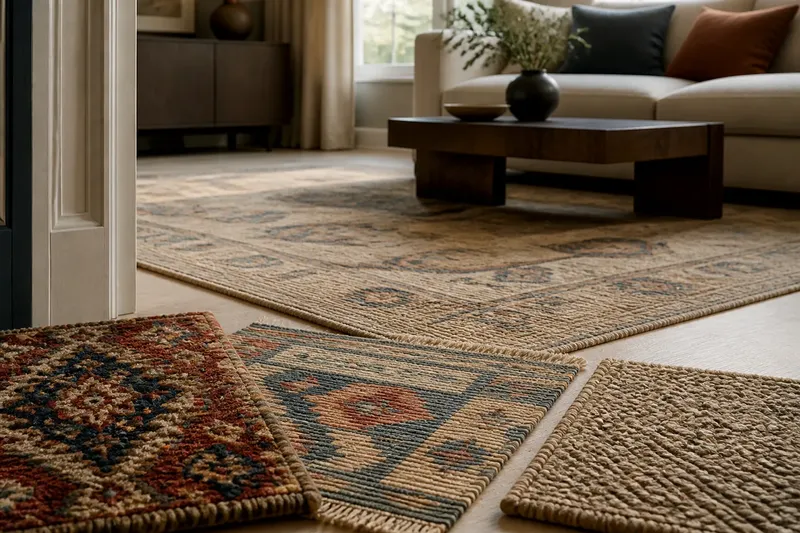
The common mistake with a rug is to read its pattern before its surface. In a woven, knotted, flat rug, the structure beneath the motif shapes how light catches it, how its edges form and how the design appears across a room. Imagine a rug first as a made object, then as a pattern.
How does rug construction shape what you see?
A rug is built from crossing or looping yarns. The arrangement determines whether the surface has visible pile, whether the design sits in a raised field or lies close to the floor, and how sharply the edges of a motif appear.
Construction is not a shopping verdict. It is a way to understand why two rugs with similar colours can read quite differently: one may cast tiny shadows around its pattern, while another presents a more even, graphic plane.
What does a woven rug show?
In a woven rug, lengthwise warp yarns are crossed by weft yarns. The specific weaving structure varies, but the crossing threads form the body of the rug and can create a surface with little pile or a more textured face. In some woven constructions, separate yarns or loops add a raised surface.
Pattern can come from the colour and placement of the yarns as they cross. Stripes, checks and small repeated shapes often suit this logic because the design is built through the interlacing itself. A woven face may show slight ridges or a change in texture where the structure shifts.
Look closely at a border or the reverse, if accessible. The relationship between the face and the back can make the construction easier to read than a photograph of the design alone. A label or maker’s description may clarify details that are not visible at a glance.
What makes a knotted rug look raised?
In a knotted rug, yarn is tied around warp threads to create individual pile points. The exposed ends form a surface above the foundation, while the knots anchor the pile in place. The pattern develops through the distribution of differently coloured knots.
That raised surface gives light and shadow a larger role. A motif may look crisp from one direction and softer from another as the pile shifts or reflects light differently. Close-up, the pattern can appear built from many small points rather than printed as one continuous image.
Knotted construction can also make outlines feel less mechanically exact. A small curve may be formed from a series of steps in the knots, a visible trace of how the image was assembled. The result is not a flaw to correct; it is a feature of translating a drawing into a textured field.
Why does a flatweave read as a plane?
A flatweave has no prominent cut pile. Its yarns interlace to make a comparatively level surface, and its pattern is commonly formed by the arrangement and colour of those yarns. The low profile tends to keep the design visually close to the floor.
Because there is little raised pile to cast shadows, a flatweave’s motifs can look clean and direct. The texture still matters: small ridges, slubs or changes in yarn thickness may interrupt an otherwise even field. A close view reveals those details; across a room, the same rug may read as a broad block of colour.
Flatwoven borders and ends can also make the construction legible. Fringes may be part of the structure rather than a later decorative addition, though that depends on how the rug was made. Construction names cover variations, so a close look at the actual object is more useful than assuming every rug with a familiar label is identical.
How can you read rug construction in a room?
Why does pile change a pattern’s appearance?
Pile introduces height, so small shadows and the direction of the fibres can soften or sharpen a design. A flat surface tends to keep its pattern more even from different viewing angles.
How can you tell a woven rug from a flatweave?
Flatweave describes a low-pile construction, while woven describes a method of interlacing yarns; those terms are not always opposites. Check the surface and, where possible, the reverse or edge rather than relying on a product photo.
Why do some rug motifs look stepped?
A design made from discrete knots or crossing yarns may build curves and diagonals from small units. At a distance, those units combine into a motif; nearby, their edges remain visible.
Does the room’s light affect how a rug reads?
Yes: light grazing a raised pile can make its texture and directional changes more apparent, while flatter construction may show a steadier field. The rug’s colours, surrounding surfaces and light source all contribute to the result.
What happened in the hypothetical room?
Say you have an invented living room with a plain sofa, a dark wood table and a pale floor. A small patterned sample looks busy when held close, so you first judge it as a motif and set it aside. Instead, you borrow a larger sample of a knotted rug and view it from the doorway and beside the sofa.
From the doorway, the raised pile softens the pattern into a field of colour. Beside the sofa, the individual knots and slight shifts in the motif become more apparent. You then compare it with a flatwoven sample carrying a similar palette: its pattern reads more evenly from across the room, while the knotted sample gives the floor a more visibly textured surface.
The decision is not that one construction suits the room better in general. In this invented situation, you choose the flatweave because its quieter surface fits the room’s existing visual texture. The useful lesson is to compare construction at the distance and angle where the rug will usually be seen, not only in a close-up or on a screen.
Which details are worth noticing?
For a quick reading, look at these features:
- Surface height: Does the design sit level with the floor, or rise into pile?
- Pattern edges: Are curves smooth, stepped, or softened by texture?
- Light response: Does the surface show directional sheen or small shadows?
- Reverse and edge: Can you see how the yarns cross, knot or finish?
- Viewing distance: Does the pattern merge into a field from the room’s usual vantage point?
There is little value in trying to identify every technical variation from a distant image. A close inspection of the surface, edge and reverse is usually enough to understand the visual distinction that matters in a room. For a particular rug, rely on its maker’s description where construction details are unclear.
Woven, knotted and flatweave describe different ways yarn becomes a surface, not a ranking of craft. Once you can see the structure, a rug’s pattern becomes easier to read at two scales: as a design across the room and as a record of how its threads meet.